
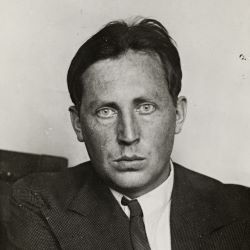
Nordahl Grieg was a poet, dramatist and novelist, born in Bergen, Norway on 1 November 1902. His father was a school principal and teacher of music at a university; his mother came from a politically active family. Grieg studied at King Frederick’s University in Oslo in 1920, then took a break to spend some time at sea. He continued his studies in Oslo from 1922 to 1925, during which time he studied at Wadham College, Oxford from 1923-4.
Grieg published a collection of sea poems Rundt Kap del Gode Haab (Around the Cape of Good Hope) in 1922 and in 1924 the novel Skibet gaar Videre (The Ship Sails On) both based on his experiences at sea. He spent 1927 in China as a newspaper correspondent; in the same year his plays En ung manns Kjaerlighet (A Young Man’s Love) and Barabbas were produced. His great love for his country can be seen in his 1929 poetry collection Norge i våre hjerter (Norway in Our Hearts).
In 1932 he published De unge døde (The Young Dead Ones), essays on Keats, Shelley, Byron, and WW1 poets Rupert Brooke, Charles Sorley and Wilfred Owen. Grieg became a Communist and spent two years in Moscow, in 1937 famously defending the Moscow trials. However, the outbreak of the Second World War and the Nazi occupation of Norway from April 1940 caused Grieg to oppose Stalin’s policies. Having served during the Norwegian Campaign against the Germans, he eventually escaped to Britain with the Norwegian court in exile and soon became a leading voice of free Norway, reading his poems on the BBC’s Norwegian broadcasts.
Grieg was also commissioned in the Norwegian Armed Forces and served as a war correspondent. In 1940 he married Gerde Egede Nissen, an Ibsen actress. On the night of 2 December 1943 he was one of several observers on an Allied bombing raid on Berlin. He joined the crew of a Royal Australian Air Force Lancaster bomber: all seven crew and Grieg were killed when the plane crashed south of Berlin.
Grieg’s poems written between 1940-43 were published in Iceland in a volume entitled Friheten (Freedom). Forbidden in Norway, the book was smuggled in the country in thousands of copies. Its most famous pieces include ’17. Mai 1940:’
We fight for the right of breathing
Now, but a day shall be
When Norsemen shall breathe together,
The air of a land set free.
After the end of World War II, Grieg became a hero in Norway because of his resistance to the Nazi Occupation, both during the invasion itself and in the continuation of the fight in the forces in exile in Britain. Grieg is still popular in Norway today, especially his anti-fascist poetry. The pre-war controversies in which he was involved were overshadowed by his war record.
Nordahl Grieg’s Poems:
Resources for Nordahl Grieg
Philip Gross FEA reads his translation of Gerde on YouTube
Nordahl Grieg reading his famous poem 17th May from NRKs on YouTube
Til Ungdommen on YouTube
The Defeat, a play about the Paris Commune Internet Archive