
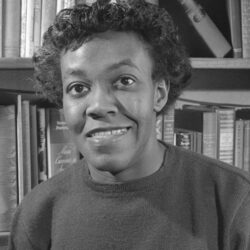
Gwendolyn Brooks was an American poet, author and teacher. Born in Topeka, Kansas on 7 June 1917, her family moved to Chicago when she was just six weeks old. She was educated at a series of integrated and segregated schools before graduating from Woodrow Wilson Junior College in 1936, giving her ‘a perspective on racial dynamics in the city that influenced her work'[1]. Encouraged by her mother, she began writing at an early age – her first poem appeared in a children’s magazine when she was 13 years old; at 17, she started submitting her work to the poetry column of the Chicago Defender, an African-American newspaper. After graduation she worked as a typist whilst she pursued her writing career. In her early years she received encouragement for her poetry from several prominent poets including Langston Hughes, Richard Wright and James Weldon Johnson. In 1939 she married Henry Lowington Blakely, Jr., whom she met after joining Chicago’s NAACP Youth Council. By 1941, Brooks was taking part in poetry workshops. In 1944 two of her poems were published in Poetry magazine’s November issue.
Her first volume of poetry, A Street in Bronzeville, was published in 1945 and included poems about the treatment of African-American soldiers during World War II. In 1950 she became the first African-American to be awarded the Pulitzer Prize for poetry for Annie Allen. In 1968 she was named the poet laureate of Illinois, a position she held until her death on 3 December 2000.
[1] Williams, Kenny Jackson (2001). “Brooks, Gwendolyn”. In Andrews, William L.; Foster, Frances Smith; Harris, Trudier (eds.). The Concise Oxford Companion to African American Literature. Oxford University Press.
Gwendolyn Brooks’s Poems:
The White Troops Had Their Orders But the Negroes Looked Like Men