
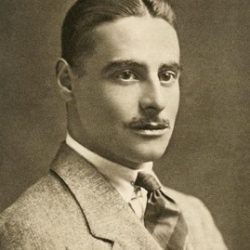
Born on December 11, 1888, Colwyn Philipps was the elder son of John Wynford Philipps, 1st Baron St. Davids and 13th Baronet of Picton and his wife, Leonora. His father said of him
A born soldier, from the moment he decided whilst still at Eton to make the army his profession he was keen to do his work well and master every branch of it. https://archive.org/details/versesphil00philiala/page/vi
He attended The Royal Military College, Sandhurst, receiving his Commission on 6 October 1908 in the Royal Horse Guards and was promoted to Lieutenant on 30th July, 1909. In June 1911, Captain Philipps led the Escort for the return of King George V and Queen Mary from Windsor, the week after the Coronation.
“Well aware that the mastery of modern warfare, a science as well as an art, required a highly trained intelligence and a great deal of common sense, he read widely to attain the knowledge that would enable him to become a good officer, taking the greatest pains to master the minutest details of every aspect of all that would be expected of him and more. He taught himself to think and write both accurately and clearly – things he believed every young officer ought to do – understanding that an ill-thought out or inaccurately worded order would almost certainly lead to unnecessary loss of life. Above all he made it his chief priority to get to know his men individually, to earn and keep their confidence, and to consider their comfort and well-being in every possible way.” Paul Chapman, Menin Gate North: In Memory and In Mourning, 19.
Colwyn Philipps arrived in France on 1 November 1914 and was at the front 3 days later, where he immediately had his first taste of battle:
“We did no good at all, never fired, but were simply a target for the German big guns; we were very lucky in having only half a dozen casualties. I expected to be frightened, or thrilled, or flurried; as a matter of fact I was bored to tears. The only interesting thing was to watch the German shells burning a large farm a hundred yards behind us. We sat in the trenches for forty-eight hours.” https://archive.org/details/versesphil00philiala/page/88
He was promoted as a temporary Captain in February 1915 and at the same time volunteered to be attached to the Foot Guards at the front (his transfer came through the day after his death).
Colwyn Philipps was killed on 13 May 1915 at the Battle of Frezenberg, near Ypres. Brother officers gave a gallant picture regarding the manner of his death in a counter-attack by two cavalry brigades, which, in spite of very heavy shrapnel and rifle fire, succeeded in regaining the original line of the trenches: he was the first man into the recovered trenches, and he killed five Germans before being shot at close quarters and killed instantly. His body was never found.
Like Julian Grenfell, he was a professional soldier who also wrote poetry. When his kit was sent home to his parents, the verse now known as ‘Release’ was found in his notebook. An anthology of his poetry was published posthumously by his family.
Colwyn Philipps’ Poems:
Resources for Colwyn Philipps
Verses by Colwyn Philipps (Internet Archive Website)