
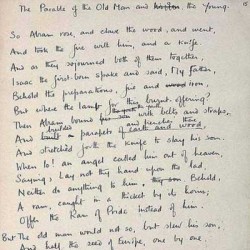
It might be worth comparing Wilfred Owen’s poem ‘The Parable of the Old Man and the Young’ with two short extracts from the novel The Good Soldier Švejk:
So Abram rose, and clave the wood, and went,
And took the fire with him, and a knife.
And as they sojourned both of them together,
Isaac the first-born spake and said, My Father,
Behold the preparations, fire and iron,
But where the lamb for this burnt-offering?
Then Abram bound the youth with belts and straps,
And builded parapets and trenches there,
And stretched forth the knife to slay his son.
When lo! an angel called him out of heaven,
Saying, Lay not thy hand upon the lad,
Neither do anything to him. Behold,
A ram, caught in a thicket by its horns;
Offer the Ram of Pride instead of him.
But the old man would not so, but slew his son,
And half the seed of Europe, one by one.
Preparations for the slaughter of mankind have always been made in the name of God or some supposed higher being which men have devised and created in their own imagination.
(Penguin edition p. 125)
An old reservist looked at the raw recruit and said: ‘Nice hope that a shrapnel tears off your head! They’ve pulled the wool over our eyes. Once a deputy from the Clerical Party came to our village and spoke to us about God’s peace, which spans the earth, and how the Lord did not want war and wanted us all to live in peace and get on together like brothers. And look at him now, the bloody fool! Now that war has broken out they pray in all the churches for the success of our arms, and they talk about God like a chief of the general staff who guides and directs the war. From this military hospital I’ve seen many funerals go out and cartfuls of hacked-off arms and legs carried away.’
(Penguin edition p. 153)
Ian Brinton October 21 2014
The text of Owen’s poem is from The First World War Poetry Digital Archive, University of Oxford (www.oucs.ox.ac.uk/ww1lit); © The Estate of Wilfred Owen. The Complete Poems and Fragments of Wilfred Owen edited by Jon Stallworthy first published by Chatto Windus, 1983. Preliminaries, introductory, editorial matter, manuscripts and fragments omitted.