
‘After such knowledge, what forgiveness?’
This line comes from ‘Gerontion’, a poem which T.S. Eliot was working on during the last months of the war. It was first published in 1920.
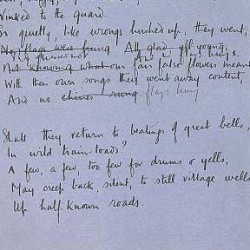
Wilfred Owen’s poem ‘The Send Off’ was written at the large army camp in Ripon in 1918. The final stanza is a dark picture emphasising the enormous gulf existing between Front Line action as experienced by troops and the steady continuation of life back home.
Shall they return to beating of great bells
In wild train-loads?
A few, a few, too few for drums and yells,
May creep back, silent, to village wells,
Up half-known roads.
It is worth comparing this picture with the closing pages of Remarque’s All Quiet on the Western Front, published in 1929: one becomes aware of the same dislocation felt by German soldiers who had spent time at the Front:
I have fourteen days rest, because I have swallowed a bit of gas; in the little garden I sit the whole day long in the sun. the armistice is coming soon, I believe it now too. Then we will go home.
Here my thoughts stop and will not go any farther. All that meets me, all that floods over me are but feelings—greed of life, love of home, yearning for the blood, intoxication of deliverance. But no aims.
Had we returned home in 1916, out of the suffering and the strength of our experiences we might have unleashed a storm. Now if we go back we will be weary, broken, burnt out, rootless, and without hope. We will not be able to find our way any more.
And men will not understand us—for the generation that grew up before us, though it has passed these years with us already had a home and a calling; now it will return to its old occupations, and the war will be forgotten—and the generation that has grown up after us will be strange to us and will push us aside. We will be superfluous even to ourselves, we will grow older, a few will adapt themselves, some others will merely submit, and most will be bewildered;—the years will pass by and in the end we shall fall into ruin.
But perhaps all this that I think is mere melancholy and dismay, which will fly away as the dust, when I stand once again beneath the poplars and listen to the rustling of their leaves. It cannot be that it has gone, the yearning that made our blood unquiet, the unknown, the perplexing, the oncoming things, the thousand faces of the future, the melodies from dreams and from books, the whispers and divinations of women; it cannot be that this has vanished in bombardment, in despair, in brothels.
Here the trees show gay and golden, the berries of the rowan stand red among the leaves, country roads run white out to the sky line, and the canteens hum like beehives with rumours of peace.
I stand up.
I am very quiet. Let the months and years come, they can take nothing from me, they can take nothing more. I am so alone, and so without hope that I can confront them without fear. The life that has borne me through these years is still in my hands and my eyes. Whether I have subdued it, I know not. But so long as it is there it will seek its own way out, heedless of the will that is within me.
Ian Brinton, October 2014
The image of Owen’s draft manuscript of The Send Off is from The First World War Poetry Digital Archive, University of Oxford (www.oucs.ox.ac.uk/ww1lit); © The British Library / The Wilfred Owen Literary Estate